(If you have not read the previous post, you might want to do that, to find out about this book. Scroll below this post.)
Questionaire:How long have you been a prepper?
What got
you into prepping?
Note from Steven: I once heard a College
Professor state that prepping (or hoarding as he called it) stems from security
issues in an individual's past. Basically he stated that people who have never
dealt with shortages or other family or security issues in their life would feel
no need to stock up on goods or learn skills for self-sufficiency: that they
would have more trust in society, government, or family to care for us. They
would also trust in the "reliability" of the "system" to keep functioning
regardless. Do you agree or disagree with his thoughts? Why or why not? Did you
have any shortages or security issues in your life that might have led you to
prepping?
What specific concerns in your area are you preparing for
(examples: earthquakes, forest or wild fires, tornadoes, hurricanes, train/truck
derailment/chemical spills etc., or ???)
Are there any events you prepare
for in a greater degree than others? Why?
To what degree are you
prepping: the short term, long term, or???? (Short term might be a three day
emergency kit while long term would be for TEOTWAWKI.)
Is your focus in
the area of storing supplies? Obtaining knowledge or skills? Becoming
self-sufficient?
On a scale of one to ten with "one" meaning "not
prepared" and "ten" meaning "100 percent prepared" how would you rate yourself
in the areas of:
Basic needs such as food, water, and
shelter:
Need for security in the areas of personal/family safety,
financial security, health:
Knowledge aside from reference books. (Is
your well-being dependent upon your library?)
Barter-able skills you
possess?
Survival skills you possess?
Do you have a prepping
library? If so, give some examples of the types of subjects covered.
What
are the most important books in your library (up to ten) and why are they
important?
Do you have tools? If so, what kind? Are they electric or hand
powered?
Do you have barter-able skills useful in an EOTWAWKI situation?
List some?
Have you ever been in "survival" mode or needed to use your
preps? Examples?
Have you relocated your home for prepping
reasons?
Do you have a bug-out location? Why did you choose this
location? How far away from your home is it? Have you made contingency plans to
get to it using alternative transportation? Have you tested these plans?
Do you plan to relocate in the future for prepping purposes? If so,
where? Why don't you live there now?
Where in the U. S. do you think
would be the best place to be living during a SHTF event? Are there locations in
a foreign country that would be better? Which one and why?
What are your
goals regarding prepping in the areas
of:
Skills
Location
Buildings or structures (fallout
shelters, storm shelters, energy efficient homes, defensive, etc.)
Power
generation
Lifestyle goals (If TSHTF are you expecting to be able to
survive as they did in the1800's? In primitive, basically stone age, existence?
Are your preps designed to keep you living a modern lifestyle? If so, for how
long?)
How do you learn new skills?
What's your favorite place to
gain information? (Internet, books, magazines, personal instruction,
etc.?)
Any provisions for family, friends, neighbors, strangers? If so,
what?
What is your favorite part of prepping?
Are you a part of a
MAG (Mutual Aid Group) or something similar? Why or why not? Would you be
interested in joining a group like that? Would you want to start one? If so,
what types of people/skills would you want to recruit?
Have you met other
preppers in the area? Why or why not? Do you want to?
Do you have a plan
for increasing your prepping needs (food stores, knowledge, skills,
etc.)
Are your food stores home produced or purchased from a supplier?
What percentage of each?
What's your occupation or career in real life?
Is it useful in the world of prepping/survival?
What's your greatest fear
in a SHTF event? In a TEOTWAWKI situation?
What do you see as the
greatest threat faced by Americans today?
If TSHTF today how would you
do? What about TEOTWAWKI?
Remember, you only have to answer the questions you want to answer. And if you don't want an in-person interview or are hopelessly far from our route, you can still be included in the book by emailing answers to whatever you want to talk about, to me at povertyprepping@yahoo.com
Monday, May 12, 2014

Poverty Prepping hits the road!
We're back in Montana after spending four months in southern Nevada doing volunteer work for the native plants program. In two weeks we'll be hitting the road again, this time to meet some of you!
As many of you know, my husband and I have written several prepper-related books. We're working on a new one; this one is about you guys! Well, sort of. It's a book of interviews with real people to let others see that preppers aren't just a bunch of scary nut cases.
We've already done the first three interviews while we were in Nevada and Arizona, and right after Memorial Day we will be heading out across the country to meet people. Privacy will be totally respected and protected, and each person will have final approval of their section in the book. Sounds about as trustworthy as National Geographic and the other prepper-related 'reality' shows? Well, we're hoping that the fact that we ARE preppers who have already met some of you and corresponded with dozens more of you, will allow a certain level of trust. We respect the TV producers' need to have drama or the unusual, in order to make money, but this isn't about $$$. We'll spend more on this trip than we'll ever make on the book.
Besides giving people a chance to see the 'real' or 'normal' side of prepping and preppers, it will be a highlight of our lives to be able to meet and talk with preppers in person. It'll be awesome to be face to face with people who come to this blog, some of whom have read some of our books, and some that have written to me on email.
We have a basic list of interview questions, which I will post today on a separate post. The questions are things like "How did you start prepping", and how long ago, are there any basic skill sets you think are important, what is your biggest weakness if the SHTF, etc. You can give as much details about yourself as you want, or very little if you don't want. You don't have to answer anything you don't want to. Pick the questions you feel like answering, or come up with some of your own. If you don't want to meet in person you could write up whatever you want, or answer some or all of the questions and email it to me.
We're leaving NW Montana the last week of May, heading across to the upper Midwest (Minneapolis, the Green Bay area, and Racine, Wis. are on the first leg), down through Chicago and across northern Indiana to Ohio. We have another interview scheduled in northern Indiana, and a bunch of them in Ohio and Pennsylvania. Then over to NY state and possibly up through New England. Down the coast as far as North Carolina, then west across Kentucky and southern Illinois into Missouri. Down to northern Texas, up to eastern Kansas, then back across the nation to NW Montana by whatever route fits. This route has been made based on already-scheduled interviews. We can add some to it, but it would be expensive to vary far from it. Some people are having us come to their houses, others are driving to meet us along our route.
There is a gathering planned at Lehman's non-electric store in Kidron, Ohio, tentatively scheduled for June 7th, but it might be the following Saturday instead. We will know at least a week ahead of time, so people will have time to plan.
In November we'll cover the west coast, heading out across northern Idaho into Washington, and on down the coast through Oregon and California. Some of our scheduled interviews in California are near Redding, Sacramento, and Ridgecrest.
I'll be posting on here along the way, not every day but when I get a chance, so you can follow the journey.
To give you an idea of what we're writing, here is a condensed version of the first two interviews:
Interview #1:
"We followed the pick-up truck as it drove away from the freeway along a two-lane highway. The area was hilly and speckled with the mid-sized evergreen trees that cover much of central Arizona. When most people picture Arizona they think of sand, cactus, and hot weather, but less than half of the state fits that description. Arizona has every type of climate somewhere in the state. The higher elevations, such as around Flagstaff in the north, have cold winters and snow. The lower elevations, primarily in the southern part of the state, have mild winters and very hot summers. The rest of the state is mainly mid-altitude and fits in between “too cold” and “too hot”.
The sun was still high in the sky when we turned onto a nondescript narrow, but paved, road much like many others we had passed since leaving the freeway. I lost track of how many roads we turned onto as we followed the winding back roads. I began to wonder how we would find our way back out to the highway again but I gave up memorizing the sequence of right turns and left turns. The pavement eventually gave way to gravel.
Finally we stopped at a driveway with a gate across it. Nothing stood out about that either. Nearly all the homes we had passed had a gate across the driveway. The homes were clearly visible from the gravel road, so there wasn't a high level of secrecy at least regarding homes and outbuildings. There were several homes scattered among the mid-height trees, which were also scattered and sparse. I wondered about the safety of a prepper among so many homes.
The properties were large enough that most houses were out of earshot, if not out of sight, from each other. It was a long drive to any place 'real', or even to the nearest store or gas station. We concluded that anyone who chose to live out there was probably pretty independent and prepper-minded, if for no other reason than a need to keep the pantry stocked and other supplies on hand. It was a lengthy and somewhat difficult drive back out to a store. The neighbors would be more likely to be the kind you could work with in a “shtf” situation than the average suburban and urban residents would be.
The prepper we were here to interview opened the gate, drove her truck through, waved us in, then closed the gate. We parked near the house. Nothing about the house said “A prepper lives here...those crazy freakish preppers!” Even entering the front door you're just thinking “What a cool vacation get-away place!” The cozy comforts of furniture and décor gave a feeling of quiet and relaxation."
Later during our visit...
"We asked why she started prepping. She said she'd always had a problem with authority and trust. She didn't believe others really were concerned about what was best for her, that the only one really looking out for her was herself. She didn't like the way things were going in the world, or how they were being handled. This evolved into food security concerns and environmental concerns. She could see how Monsanto and other corporations were working to control our food. She saw that we are good at making war and doing devastating things to other people and our planet, mostly just to gain power and unbelievable amounts of money. Religion was all about control and power as well.
One of the things she likes about prepping is the things she gets to buy and have. She gets fun “toys” and is always learning new things. She considers her bug-out house a prep and her dog is a prep, not just the food and things that are stored. The dog is a prep because, among other things, it can keep watch while she sleeps on the trail if she has to bug out. Dogs are great early-warning systems, in addition to being good company. But it isn’t just about the things she has, it’s also about learning to be flexible and adaptable no matter what the circumstances. She doesn’t feel dependent on her preparations like stored food. All of her “stuff” can disappear in a heartbeat, but no one can take away her knowledge and ability to survive."
Interview #2:
"I leaned into the car to set down the armload of gear I carried. We were about to embark on a kayak trip and only minutes away from leaving for the jump-off point. The morning was already warm and I wiped the back of my hand across my forehead as I stepped back from the car and started to turn. A voice called my name from the bushes south of camp and a man came striding out.
Our dog stood by my legs slowly wagging her tail, so apparently she didn't detect a threat, but I turned and called my husband's name toward the direction of the camper, then greeted the man. Moments later the three of us were settled in lawn chairs and he told us his story. Five hours later we were still hanging on the edge of our seats.
“Bill” had been in the military and then worked for the government. He didn't reveal which branch of the military or what he did for the government. He said he was in the lab when dragonfly camera technology was cutting edge, about twenty years ago, and speculated with wonder in his voice about what sort of cutting edge technology is in the lab now days. The public only found out about the dragonfly cameras a few years ago, so he figured whatever they had now behind those closed doors would make science fiction look like child's play.
Concern about the direction the country was going in made him think about the future. He bought land in NW Utah, “behind the lake”, he said. It was an eight-acre parcel and had an old house on it. Bill bought solar panels and a wind turbine, and put in gardens and fruit trees. He had food storage stashed there, as well as other supplies and hand tools. So far it sounded pretty classic. I wondered about the past tense of his story. “Then there was the accident...” he said. I leaned forward and set my glass of lemonade on the tray next to my chair.
In the book you'll read what happened, but here was the result: Bill suffered a brain injury so bad that it took a few years to learn how to talk and feed himself again. He'd stare at a weird-looking bottle on the counter and try to remember the word “Ketchup”. He'd stand in the kitchen of his home and know that it was his house but he couldn't remember how to find his bedroom or the bathroom. He'd look at his wife and he knew it was his wife but he couldn't remember her name.
They had to sell their prepper homestead: The property he owns now is set up with good gardens and fruit trees. The weakness is water and firewood. He has two wells, one of which is over 400' deep and he was trying to figure out how to get water out of it if the SHTF. He was going to research solar-powered water pumps but wasn't sure they'd pump from that deep. The other well is a shallower well but it hadn't been tested for safety for drinking, and the property is in an agricultural area. Chemicals used by farmers could be in the water. The property has another weakness that is even more threatening than the water/wells. There are no trees and it's in a cold climate.
One of the biggest threats he sees today is the people themselves. “We're too polarized. Everyone is divided on just about every issue. There is no trust. The nation is a powder keg, and at some point someone is going to fire the first shot. And they have no idea how bad it's going to get. It's like a game to them.”
As suddenly as he had arrived he stood and said good-bye and walked off through the bushes. His calm, slow voice still sounded in my head. “I'm not sure there is anywhere that is better than any other place. They can see and hear everything.”
Check back later for another post with our questionnaire, which is really just a guideline in case my brain stalls and I forget what to ask people! :)
Please leave comments below or email them to:
povertyprepping@yahoo.com
Thanks!
Susan (and my husband, Steven)
Tuesday, April 8, 2014
Using freeze-dried food storage
(If you just want to look at the pictures and read about the foods, you can scroll down past the text)
For the past few winters we've left NW Montana once winter has been well under-way long enough that we get tired of looking at snow and having below-zero weather. Up on the mountain where our cabin is located it starts to snow any time after mid-October. Most years it starts sticking on the ground by early November and we don't see bare ground again until late April. Some years it's been into the first week of May before the last of it melts.
To break up the monotony of long Montana winters we started going to southern Nevada and "boondock camping" for a few months. We decided to tie the practice of survival preparedness skills into these trips, since like all things in our life, things are only possible if we don't have to spend money. Money is a scarce commodity. So the first year we challenged ourselves to leave Montana with pretty much all the food we would need for those 3 months. I had about thirty 2-gallon buckets full of things like flour, sugar, beans, rice, corn, oatmeal, and other dry foods. We took a lot of can goods, mostly home-canned, and all the spices and such that we use in cooking and baking.
We also challenged ourselves to learn about foraging and using edible food from the desert. The Mojave is abundantly blessed with edible plants and animals. The only "animals" we were able to harvest legally was jackrabbits. No license is required for either residents or non-residents in Nevada for jackrabbits or coyotes, but we weren't hungry enough to try coyote-burgers! The jackrabbits are lean and tough, but they make a tasty stew (with fresh warm homemade biscuits) or potpie.
Edible plants were mainly cactus this time of year. Later in the year there would be fruit from the cactus flowers and yuccas, mesquite beans, pine nuts from the Pinyon pines at higher elevations. We did a lot of reading about how the Paiute Indians and their predecessors, the Anasazi, lived from the land in this area. I'm happy to say that we spent almost nothing on groceries the whole time we were down here. The only "expense" of the trip was the gas to get down here and back. We probably saved money in the long run because our phone company let us put the phone/internet on "vacation" since we'd be gone longer than a month, and there was no expense for heat during those few months.
The next time we came south we brought a bunch of home-canned and home-dried food. I spent weeks back home cooking up beans and rice and potatoes on the woodstove, since we had to heat the house anyway. Then I dried those foods on racks placed on shelves behind the woodstove. I dried fruits and vegetables and dairy products (sour cream, cottage cheese, yogurt). I also canned meat, cheese, and butter. Again, we brought the buckets of dry food. Also again, we spent almost nothing on food. I have to admit to the occasional pizza from the grocery store, and something they call "sticky chicken", which is like boneless sweet-and-sour wings, from the grocery store deli.
This year we came similarly stocked, but the local grocery store here has started carrying freeze-dried food in #10 cans, which are those cans that are about a gallon in size. We bought a few cans of things that would make our life without refrigeration more comfortable, like the scrambled eggs and cheese powder, but mostly we just eyed the cans when we were in the store,
shying away from the cost.
Then they had this wonderful thing called a "Stock-up and Caselot sale" and included were all the cans of freeze-dried foods! Most were about $5 off the regular price, and we bought quite a few of them. The veggies were the cheapest, usually under $10 a can. The fruits were mostly in the $15 to $17 range. We blew pretty much our whole winter's food budget on those cans, but we have plenty of dry foods and canned goods, so even if we don't get to spend another dime on food down here, we'll still eat well.
I'm not promoting this company in particular. It just happens to be the one the store carries. I have used other freeze dried foods from companies like Pioneer Foods and Mountain House and find them all to be comparable in quality. However, Augason Farms is the company these foods in this post are from. Here's a link to their products on Amazon in case you want to look at or try any of these things yourself:
I did notice while browsing that the prices were higher than at our local grocery store, and especially higher than the sale cost was. You might want to check your local grocery store or even Wal-Mart. The Wal-Mart on the east side of Flagstaff, Arizona carries the largest supply of Augason freeze-dried foods that I've seen anywhere on a store shelf. They even have cool stuff like freeze-dried Turkey tetrazzini and Chicken Alfredo, with real meat! They also have cans of real dried chicken and beef. I've seen the TVP versions of "beef" and "chicken" in many grocery stores in freeze-dried and other forms, but this Wal-Mart carries the real freeze-dried meat.
We stared at our cans for a few days, wondering if we should use them or just keep them in case the SHTF while we're down here and we needed food for a longer period of time. Finally we started opening and using them. Some cans haven't been opened yet, but some have and we've been using them. Here is a rundown on our experiences.

These are freeze-dried raspberries. Sorry the pictures don't look very clear. They did when I took them, but I uploaded them in town at the library since our mobile wifi doesn't have enough data to do it out here in the boondocks. I didn't notice at the library that they were fuzzy, and we're back out in the middle of nowhere now.
The freeze-dried raspberries are delicious right out of the can. They're dry and have a texture similar to stryofoam, or Cheetos, but have a strong raspberry flavor. They've even more delicious after re-hydrating. These and all of the freeze-dried food we've been using are best if you use almost-boiling water and just cover them. They don't swell up as much as dehydrated food sometimes does.
After about ten or fifteen minutes you have a product that is very similar to thawed frozen berries. We've used these in oatmeal, pancakes, muffins, and once on vanilla ice cream.

These are freeze-dried blueberries. They're practically tasteless out of the can, and only somewhat more tasty after soaking in hot water. There is a good but subdued blueberry flavor. They're good in oatmeal, pancakes, and muffins.

Our favorite! Freeze-dried strawberry slices. If you like strawberries at all, you'll have a hard time not eating the whole can just as strawberry chips! They, too, have a texture like Cheetos right out of the can but with a strong and delicious strawberry flavor. They're similar to thawed frozen strawberries after soaking in hot water. We've used them in oatmeal and pancakes, and also stirred into vanilla ice cream, on a different occasion than the tie we used raspberries.

Freeze dried strawberries without my hand in the picture!
That packet is an oxygen absorber, which comes in every can.

Freeze-dried raspberries without my hand in the picture.

Freeze-dried blueberries.

This is that the cans look like. Again, I apologize for the grainy picture.
Blueberries on top.
Strawberries on bottom left, raspberries on right.

This is freeze-dried Cheesy-Broccoli soup. It's delicious.
To make it you mix the soup powder with hot water and then heat it for a few minutes
in a pan on the stove.

Freeze-dried vegetable stew. It has carrots, celery, cabbage, potatoes, onion, and peppers in it. I thought it would be bland but it's very flavorful. I add rice to it and cook it all at once, and the stew rehydrates as the rice cooks.

Vegetable stew on top.
Cheesy Broccoli soup on bottom left, Creamy potato soup on bottom right.
We haven't opened the potato soup yet. I have fresh potatoes left from our garden
in Montana that we are finishing up first.

The vegetables!
Freeze-dried carrots on top left, Broccoli florets on top right.
Corn on bottom left, peas on bottom right.
None of these are open yet. We're using up home-dehydrated and canned
vegetables first.

Breakfast anyone? On top we have freeze-dried butter, which could be used on homemade bread or toast. We haven't opened the butter yet because we brought home-canned butter.
Omelet, anyone?
Freeze-dried whole eggs on top left, Freeze-dried bacon bits on top right.
Feeze-dried onion bottom left, freeze-dried red and green peppers bottom right.
The bottom four cans are all open and half gone, except the bacon bits which seem like
they'll last forever!

This is what the freeze-dried bacon bits look like. They're actually imitation made with soy tvp stuff, but they're flavored nicely. Almost a smoky barbeque flavor reminiscent of bacon but not quite. They did pretty good with it though. We soak them right in the hot water with the onions and peppers when we're using them in omelets. They're good on salads right out of the can.

This is the freeze-dried whole egg powder. They also make a freeze-dried scrambled egg mix that we like even better than the whole eggs. Both work great in baking and help cakes and other foods rise wonderfully. For scrambled eggs or omelets we whisk the egg powder (either kind) in hot water and let it sit on the counter for about five minutes. Once it's in the pan and cooking, we add the bacon bits and veggies. Before the cheese powder ran out we would mix and pour some of that on the eggs when they were almost done.
If I'm baking with the egg powder I put the measure of dry powder in with the dry ingredients,
and just add the measure of water it would call for, to the wet ingredients.

Freeze-dried red and green peppers. We use them in just about all of our dinners and in eggs when we have them for breakfast. They are nearly like fresh chopped peppers when soaked about ten minutes in hot water. I drain and air-dry them, fluffing them apart with my fingers every few minutes.

Freeze-dried onions. These have a strong onion-y smell, more so than the ones I dehydrate at home. But they add a terrific flavor to everything I cook. Normally I give them the ten-minute soak in hot water, but I have just tossed them in while I was making casseroles and they rehydrated while the casserole cooked.
Not pictured here, and I don't know how I missed it, is a can of potato cubes. The can isn't open yet but I plan to use it with some of the vegetables above and some home-canned meat to make pot pies and stews.

Freeze-dried apple slices. I soaked some in hot water for about fifteen minutes and made a pie out of them. The apple slices were just slightly rubbery, so maybe I could have soaked them longer but the flavor was great. Sometimes we use these along with a bit of cinnamon in oatmeal. I just cook the dry slices right in the water with the oatmeal, then cover and let sit about five or ten minutes,
then we eat it. It's delicious.

The can of apple slices.
Hmm..this one says dehydrated. I thought the were all freeze-dried? I just looked and most of the
other cans say freeze-dried.

Banana slices. These are hard and crispy and they don't "reconstitute".
They're a delicious snack though.

Here's the can of banana slices.

The freeze-dried chili mix on the left is Augason farms. It has everything in it: beans, meat, tomatoes, the works. It's not open yet so I can't tell you more about it yet. I'll have to either update this or make a new post about this and the others as we open them.
The Mountain House beef stew is not open either. We got it from a neighbor. It was part of a Y2K stash. We have used other mountain house dried foods and they were exceptional in quality, for ease of use, taste, and texture.

This "Morning Moo's" milk alternative tastes a lot like the product "YooHoo", a chocolate drink that you can buy at most grocery stores in small cans or in boxes with straws. It says "milk alternative" on it but it contains whey and powdered milk. If you have a true milk allergy, this isn't for you. If you want a product that is tastier than mixing nesquick with powdered milk, this is definitely tastier. I forgot to take a picture of the contents but it looks like any cocoa powder.

This raw diced beef was also part of that Y2K stash that our neighbor gave us.

Here's a picture of the beef pieces. They have a texture like Cheetos or Styrofoam, but a strong beefy smell. We soak them in hot water and then make them into gravies, stews, and casseroles. We fried them in a bit of olive oil once and while they tasted good the texture was kind of chewy. That chewiness goes away while they simmer in gravies and stews and casseroles.
A delicious meal is homemade egg noodles with some of these beef chunks, some dehydrated mushrooms, dehydrated onions, dehydrated celery, and dehydrated sour cream. Sour cream dehydrates wonderfully. Use a fruit leather tray and spread it thin. Dry it until it's brittle.

This picture is to show a #10 can next to a standard 15-oz. can of peas, in case there are readers who aren't sure what a number-ten can is.
It's been a fun adventure trying out these products. I look forward to using the ones we haven't tried yet and I'll keep you posted when we do. We're only a few weeks away from returning to our cabin in the north and getting the garden started, so we may not open any more of these cans before then.
For the most part we plan to continue growing and preserving our own food. This has been an interesting experiment and it's been fun seeing what it's like to buy and use commercial food storage products. These foods aren't organic, so possibly it's not any more healthy than the rest of the food in the grocery store. For the best health and long-term food storage plan, learning how to grow your own food, using heirloom seed and saving seed for the next year, and preserving your own food using any of the food preservation methods, is the best way to insure a healthy meal on your table and long-term survival of you and your loved-ones
Please leave comments below or email them to:
I'm way behind on answering emails and I apologize to those of you who are waiting. I've been getting a huge amount of emails from people with questions and sharing their experiences, and I enjoy getting them, but I'm having a hard time tracking down some answers and I've gotten behind on reading and answering letters, along with all the other tasks of the day!
Thank you!
Susan
Tuesday, February 25, 2014
Sigh... stolen books again.
Well, three of my books have turned up on pirate and bootleg sites again, and those are just the ones we know about. here I thought the big drop in sales this month was just the February slump.
I won't burden you with an accounting of how much this hurts our already-suffering finances, with all these unexpected medical and dental bills and now the transmission out on our car. Walking and bicycling is better for our health anyway, right.?
So I'll just tell you that I sat here weeping this morning when I found out. It's not a victimless crime. It really isn't. I spent time researching and writing those books. Dave spent time researching and writing a lot of it too. My husband spent time helping edit and format the books, and making the covers. All of that between regular work and gardening and caring for grandchildren, etc. We put our hearts into these books.
We're not machines or corporations, and this is not a get-rich -quick scheme designed just to part people from a few dollars a book. We expected to earn some money for our work but we did keep the prices as low as we could. Amazon takes their chunk, and for the print books the publisher/printer takes another chuck. We get around $1. 44 to $2.00 per sale. It takes a lot to add up.
If you have gotten these books from any site other than amazon, you have gotten stolen books. NO ONE EXCEPT AMAZON IS AUTHORIZED TO SELL OR DISTRIBUTE DOWNLOADS OF THESE BOOKS!
No one except amazon is authorized to sell Print copies. The only time that might be legal is if someone is selling a used copy they legally bought. One site is selling new copies for full price, yet the only legal way they should be able to get it is buying them at full price. So how are they doing this and still making money? I haven't found out yet.
Please don't steal. Don't steal anyone's work and livelihood, whether it's books, music, movies, or a candy bar from the local store. It does hurt.
Most free downloads of published books are stolen. Amazon free downloads are legal and approved by the authors. All these other sites are offering stolen books, a lot of them written by people like you and I.
***UPDATE*** 3/09/14 -- Dave just sent me an email with more than 15 sites giving away my books for free. I'm sure you can imagine how I feel having my work stolen and distributed.
Please leave comments below or email them to povertprepping@yahoo.com
Susan
I won't burden you with an accounting of how much this hurts our already-suffering finances, with all these unexpected medical and dental bills and now the transmission out on our car. Walking and bicycling is better for our health anyway, right.?
So I'll just tell you that I sat here weeping this morning when I found out. It's not a victimless crime. It really isn't. I spent time researching and writing those books. Dave spent time researching and writing a lot of it too. My husband spent time helping edit and format the books, and making the covers. All of that between regular work and gardening and caring for grandchildren, etc. We put our hearts into these books.
We're not machines or corporations, and this is not a get-rich -quick scheme designed just to part people from a few dollars a book. We expected to earn some money for our work but we did keep the prices as low as we could. Amazon takes their chunk, and for the print books the publisher/printer takes another chuck. We get around $1. 44 to $2.00 per sale. It takes a lot to add up.
If you have gotten these books from any site other than amazon, you have gotten stolen books. NO ONE EXCEPT AMAZON IS AUTHORIZED TO SELL OR DISTRIBUTE DOWNLOADS OF THESE BOOKS!
No one except amazon is authorized to sell Print copies. The only time that might be legal is if someone is selling a used copy they legally bought. One site is selling new copies for full price, yet the only legal way they should be able to get it is buying them at full price. So how are they doing this and still making money? I haven't found out yet.
Please don't steal. Don't steal anyone's work and livelihood, whether it's books, music, movies, or a candy bar from the local store. It does hurt.
Most free downloads of published books are stolen. Amazon free downloads are legal and approved by the authors. All these other sites are offering stolen books, a lot of them written by people like you and I.
***UPDATE*** 3/09/14 -- Dave just sent me an email with more than 15 sites giving away my books for free. I'm sure you can imagine how I feel having my work stolen and distributed.
Please leave comments below or email them to povertprepping@yahoo.com
Susan
Tuesday, February 18, 2014
I'm Okay
Sorry for taking so long to post an update. I'm okay. The troublesome teeth are gone and I'm recovering. Still have to go in for some fillings and stuff. In the meanwhile I've been doing a lot of reading and research, and I just don't understand why dental insurance isn't offered as something as important as general health insurance. The health of our teeth is crucial to our entire body for many reasons. Yet few people have dental coverage. Medicare doesn't cover dental. Most Medicaid doesn't cover it either, except some will do basic fillings and extractions, in some states, and sometimes only for children.
Dentists can be expensive, but then they went to a lot of years of school and usually have HUGE student loans to pay back, and they have to carry insurance and pay the expenses of the clinic and equipment. Do they sometimes live in nicer houses and driver nicer cars? Yes. But they went to all those years of school to be able to be a dentist and in my opinion that gives them the right to a better house and better car than I have. My most-skilled job was a short stint as a sheriff's department dispatcher with on-the-job training. My other jobs were things like grocery store cashier with a scattering of restaurants and such in my early years. I don't expect or deserve the same as someone who went to college and med school.
There are cheaper options for dental work. Some places have free or sliding-scale county health departments that offer dental work. Lincoln and Flathead counties in Montana do. I don't know about your area. The biggest problem with these can be the long wait for an appointment. A few years ago it was four months in Lincoln county but I don't know what it is now. You might not have that much time to wait. Some dentists will work with you on payments, but you might have to shop around one that you can make that fit with.
For some people it's a matter of priority. I ended up without a choice and had to do this NOW, but I could have taken care of it sooner. But it wasn't a priority. No one likes having to spend their money on things like the dentist. But if you don't, you might not be around at all to spend any money.
I read that on average 67 people a year are admitted to the hospital from the emergency room for dental infections, and I read of at least two that died from them. Some of these people spent a week on IV antibiotics to save their lives. The more times you have an antibiotic, the more likely your body is to be resistant to that antibiotic the next time. Eventually you could be at a big risk from ANY type of infection in the future if the doctor can't treat you with an antibiotic. The more you can avoid the need for an antibiotic, the better.
Some things can be treated with alternates to antibiotics such as an essential oil like Oregano (use with caution and read up about it before you try it!). Some things with herbs. But as preppers most of you know that when antibiotics aren't available we will face a lot of tragedies. So please... do make sure your teeth are maintained in the best condition you can to give you the best edge possible if the SHTF. Do the same with your body. Treat it well. Take care of it. Maintain it when you need to.
Thank you for all the letters of encouragement and support, and for sharing your stories. Some of you have been through worse than me, and I was really touched by your stories. (I think I've finally gotten them all answered). The worst part with me was the infection coupled with blood pressure too high to make it safe for the dental work that would end the infection.
I'm glad to still be with you all.
Susan
Dentists can be expensive, but then they went to a lot of years of school and usually have HUGE student loans to pay back, and they have to carry insurance and pay the expenses of the clinic and equipment. Do they sometimes live in nicer houses and driver nicer cars? Yes. But they went to all those years of school to be able to be a dentist and in my opinion that gives them the right to a better house and better car than I have. My most-skilled job was a short stint as a sheriff's department dispatcher with on-the-job training. My other jobs were things like grocery store cashier with a scattering of restaurants and such in my early years. I don't expect or deserve the same as someone who went to college and med school.
There are cheaper options for dental work. Some places have free or sliding-scale county health departments that offer dental work. Lincoln and Flathead counties in Montana do. I don't know about your area. The biggest problem with these can be the long wait for an appointment. A few years ago it was four months in Lincoln county but I don't know what it is now. You might not have that much time to wait. Some dentists will work with you on payments, but you might have to shop around one that you can make that fit with.
For some people it's a matter of priority. I ended up without a choice and had to do this NOW, but I could have taken care of it sooner. But it wasn't a priority. No one likes having to spend their money on things like the dentist. But if you don't, you might not be around at all to spend any money.
I read that on average 67 people a year are admitted to the hospital from the emergency room for dental infections, and I read of at least two that died from them. Some of these people spent a week on IV antibiotics to save their lives. The more times you have an antibiotic, the more likely your body is to be resistant to that antibiotic the next time. Eventually you could be at a big risk from ANY type of infection in the future if the doctor can't treat you with an antibiotic. The more you can avoid the need for an antibiotic, the better.
Some things can be treated with alternates to antibiotics such as an essential oil like Oregano (use with caution and read up about it before you try it!). Some things with herbs. But as preppers most of you know that when antibiotics aren't available we will face a lot of tragedies. So please... do make sure your teeth are maintained in the best condition you can to give you the best edge possible if the SHTF. Do the same with your body. Treat it well. Take care of it. Maintain it when you need to.
Thank you for all the letters of encouragement and support, and for sharing your stories. Some of you have been through worse than me, and I was really touched by your stories. (I think I've finally gotten them all answered). The worst part with me was the infection coupled with blood pressure too high to make it safe for the dental work that would end the infection.
I'm glad to still be with you all.
Susan
Tuesday, February 11, 2014
Take care of your TEETH!!!
Twenty-two years ago I had the first tooth crack. It was an upper molar and back in enough to not really be visible. However, I went to the dentist like I should. He wanted money up front before he would work on it. We were a normal suburban couple, working and raising a batch of young children. At the time, we had no health insurance and no dental coverage, and no Medicaid. Everything we had went to the kids, to keep them healthy and their teeth in good shape, and eyeglasses on the ones that needed them.
Besides...the tooth didn't hurt. It was easy to ignore. I shrugged and thought 'oh well', and went on with life. I've always been the one in our family that took good care of my teeth. I brushed them on nights when everyone else was exhausted and went to bed without brushing. I flossed, when my kids just did so hit & miss. I rinsed with either half-and-half water and peroxide, or mouthwash.
Time went by and another molar had a piece broke off. That one didn't hurt either, though it cut up my tongue a lot while it was sharp, and eventually it wore down to where my tongue was okay. My front teeth, all the visible ones, were still in great shape. So again I just went on with life.
For a lot of years my teeth stayed about the same, but as I passed my middle-40s more of my molars started to break. Still no pain, which was a real downfall. If I had some bad toothaches I might have taken it more seriously and gone in to the dentist. I was sad with each piece that broke off. But I went on with life, working around the growing gaps back in there.
Then I started to get the occasional absess. Sometimes I could take care of it myself by hitting it hard with saltwater gargles and peroxide rinses, and cutting all sugar from my diet for a couple of weeks. In my body, at least, there seems to be a correlation to the sugar thing when I have an infection. So once again, I had it handled. I was fine. Life went on.
Last November, 2013, I felt really sick one day in town. A vein in my neck was swollen and throbbing. It looked like one of those cartoon hearts popping out and in. My collarbone hurt. I felt generally icky, but no pain in my mouth or teeth. I had no clue at that time that they were related. We thought I had a blockage and was on the edge of a stroke. I was kept in the city over night on stroke watch and my blood pressure was high, which made it even more likely.
The next day an astute doctor looked in my mouth and said it was a dental infection. He prescribed an antibiotic and told me I should get the teeth taken care of soon. And I was out the door. The antibiotic did the trick, for the time being. They prescribed penicillin that time, and I went on my no-sugar diet again. I mainly ate fresh, unadultered meat (usually our own venison) and fresh or frozen unsalted/unsugared vegetables, and things like plain oatmeal with berries in it, no sugar. The infection cleared up and as a by-product I lost 15 pounds in two weeks. I stayed fairly good on my eating until we got into January.
And let me emphasize that...I stayed fairly good on my eating, and I missed all the candy and pies and stuff throughout the Thanksgiving and Christmas season. I ate one tiny piece of pumpkin pie on Thanksgiving, and one small piece of peanut butter candy at Christmas. That was my ONLY sweet treats the whole season.
Then after New Year's we came down to southern Nevada to work for the park service at Lake Mead until May 1st, and my diet got gradually crappy until before long I was grabbing stuff off the dollar menu at McDonald's or buying cheap mac & cheese boxed dinners and hamburger helper, buying pizza and baking it. I even broke my vow to not drink pop again and had pop a couple times in late January. Then Dairy Queen had a "customer appreciation day" and everything was half price. I had a banana split in the early afternoon...and a hot fudge sundae at dinner time. Later that night I felt the first prickliness in my cheek on the right side.
I knew I was in trouble. Yep, sure enough the vein in the neck was throbbing. By morning my collar bone ached. Infection was back. I was an idiot. I was also 1,100 miles from home. It was a Saturday. No dentist was open.
Well, no problem, the Wal-Mart store near here has a walk-in clinic. I decided I'd just run in there and get a prescription for an antibiotic. All went well and they took me back into a room and asked some questions and weighed me (I'd lost another five pounds! Ha!), and then... they took my blood pressure. :O They sent me straight to the emergency room, got me right in ahead of a bunch of people and hooked me a billion things and had me scared to death, talking about my arteries just popping out from my heart and justlikethat I'd be gone. My mind was in a whirl. I never felt so scared of actually DYING as I did then.
My blood pressure was 238 over 118. Kinda high, huh? Just HEARING that shot me into an adrenaline rush and I had a huge panic attack. They gave me more stuff. I had a nitroglycerin patch on me, and they gave me four aspirin and piles of other meds, plus some antibiotics into an IV. It took them FIVE HOURS to bring my blood pressure down to 194 over 89. Then they gave me a pile of prescriptions and released me.
I made an appointment with a dentist, which was easy to do. Well, the first place I called never answered the phone except a recording that finally stated their hours and that if it was business hours it meant they were busy and couldn't answer the phone. I had done a google search on the dentists in the area. The next one I called I chose because I liked the look of the dentist and his staff, and I liked that their website had personal things, like pictures of the dentist with his dogs, and he is a cyclist, as am I, and also supports a local cycling team. They answered just before the second ring and got me scheduled for the next morning. The gal I talked to was sweet and patient.
Getting in to a doctor was something else. The hospital gave me the name of their doctor-on-call who was supposed to get me in in a timely manner by being referred by the hospital. They had a 2-week wait. I couldn't wait.
I cleaned my diet up immediately and kept up with my walking and exercising, and kept my dentist appointment. They were great. I was embarrassed about how many bad molars I had back in there but they treated me with respect. They were ready to take the molars out on the spot except for one thing. My blood pressure was up. It was 212 over 119 right there in the dentist office.
They brought in their complimentary massage person to relax me. She brought in her chair and I had the first massage I've ever had in my life, all while she talked to me calmly in her lovely New Zealand accent about two horses she adopted as rescue colts. I could have relaxed just listening to her talk. But when they took my blood pressure after half an hour it was almost exactly the same.
The dentist called a few doctors in the area but none could see me for at least a month. The only one he found that would, was a concierge type doctor practice and I would have had to pay a $1,500 'membership' up front, plus the doctor fees. *cough cough* I think that's out of most people's range and it was out of ours. So...back to the emergency room to get the blood pressure meds upped. This time they also gave me an anti-anxiety pill to take too.
Now, I'm an herb-type person who has always been able to treat whatever came up by myself. It really rubbed me the wrong way to be filling my body with all this stuff. But at this point it was either that or die. The dentist said it was critical to get this done as soon as possible. The antibiotics only work so long. And this one already had not been working this time and he had to switch to another antibiotic. We couldn't wait for the doctor appointment. So all stops were pulled out.
Starting Friday I went all vegan, and no salt, no sugar (I don't use artificial sweeteners either). All I've been eating since Friday (Today is Tuesday night) is plain old-fashioned oatmeal with plain berries in it, pumpkin puree stirred into plain unsweetened almond milk with a little bit of cinnamon. Bananas, apples, carrot sticks, plain rice cakes (no sodium) with unsalted/unsugared almond butter on them. I've gone for walks and bicycle rides every day.
Yet over the weekend the best I could do was getting it down into the 140s over the 90s. And they hoped for it to be lower. Finally yesterday it started to come down more, except when certain stresses (like the 3-year old grandson we're raising getting loud and whiny) caused it to go up some, but even then it was pretty much just the 140s over 90-ish area.
Today it's been good. 130s over 80-ish most of the day. They gave me the green light for getting the dental work done tomorrow. The unsavable molars will be removed and the savable ones fixed. They tell me that I should start feeling better, and that the low-level inflammation that has probably been circulating through my whole body from the bad teeth, will start clearing out and my arteries will become healthier again and my blood pressure should drop on it's own.
That is... if I live. The likelihood is that I'll do fine. But my blood pressure could spike during the procedure and put me into cardiac infarction or stroke or other ways of probable death, or at least permanent damage. I feel like I'm in good hands, and the staff has kept in touch with me during all this and offered me all kinds of reassurance that they'll take good care of me. The hospital is right across the street from the dentist office.
The reason I'm writing all of this to you is to bring dental awareness to the foreground. Most of you who read these posts are preppers. And as preppers we should make sure all of our medical needs are attended to and updated. If the SHTF tomorrow, do you have bad teeth that should have been taken care of? My recommendation is to GET YOUR DENTAL WORK DONE!!! Be in a state of readiness for anything by not leaving that. Same with any medical concern you have been letting go. Get it taken care of.
If you've seen the movie "Castaway" with Tom Hanks, then you saw him dealing with an absessed tooth he put off having fixed before the plane crash. It nearly killed him and he had to knock the tooth out himself to save his life. He passed out but he lived. I'm not sure I could have brought myself to do that.
Even if you're not a prepper, bad teeth can ruin your health, destroy your heart, cause hardening of the arteries, and kill you from the infection.
Yes, it's expensive. Find a dentist who will work with you. Or start making it a priority and save money for it, and see if you can get started on the work as you pay for it. And do it before things get this bad. Not only will my bill be higher because I let it go so many years, but I also have two emergency room visits to pay for too. This isn't going away for a long time. We'll be paying on it for months, but I will be glad to still be around to pay for it.
By the way... the tingling I felt in my cheek? It's nerve damage from the infection (which wasn't causing me any pain, by the way) and it was also eating into my jawbone. If I had left this go long enough, and lived to do something about it, I would have been to the point of needing jaw reconstruction. As it is, I may feel a slight tingling in my cheek the rest of my life.
To look at my front teeth you'd have never guessed. What all are you hiding?
Susan
povertyprepping@yahoo.com
Sunday, January 19, 2014
Food Storage Tips - Guest Post
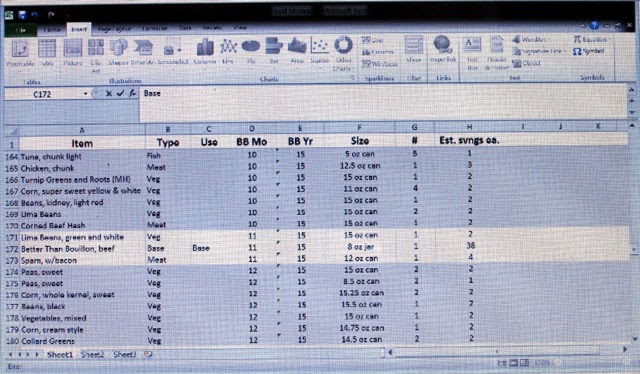
I love the emails I get from readers, and every now and then someone shares their story. When I emailed this woman back and asked if I could use it for a blog post, she not only said 'yes', she emailed me a copy of her spreadsheet and a picture!
"When I started prepping I had more extra money every month than I do now, but even then I had to be careful. I made a rule: anything on my shopping list that I know I will need or want in hard times, I would buy at least one extra for storage. I prefer fresh vegetables, so if I were buying fresh corn, then I also bought a can or two of corn, if it was on sale. I increased my shopping budget for about 6 months, but I have a good pantry full of things I know I will enjoy in an emergency.
I needed storage space for food, so I went on a hard core cleanup, donating or throwing out things that were less important to me than food would be in an emergency. That was tough at the beginning but is easy now. I look at old games or books or clothes and throw enough away to make room for one meal, or a week’s worth of meals, or whatever.
Then, because I could not stand the idea of allowing any of this hard-won food go to waste, I organized my food by expiration dates. So, everything that expires in Jan 2014 is together – milk powder, vegetables, meats, bouillon, etc., and then all the food for Feb 2014, and so forth. Naturally, everything in storage has its expiration date written on the front with a Sharpie.

Everything is in the pantry but on the first of each month, I bring next month’s food into my kitchen cabinet and look for recipes to use every scrap before it expires. I’ve learned to make new dishes and can say proudly that nothing has been thrown out!
Because I wanted easy access to food I might need, I also made a spread sheet of all my food on the computer and can search for “tomatoes” if I run short. So, the next rule is: replace anything used from storage. The system works well for me because I am forced to use food by expiration date rather than running the risk of missing the use of something located in a group of its kind. The next 2 rules: remove any item from the spreadsheet that is removed from the pantry and add newly-bought items to the spreadsheet before putting into the pantry.

For “treats” I have collected a variety of local honeys, which I absolutely adore. I have also bought large containers of raw honey for medicinal purposes in a time of great need. Honey is yummy, has antibacterial properties, and can be stored easily forever. The perfect food!
Oh, yes, and I used my tax refund for freeze-dried meats, vegetables, and fruits instead of the vacation or clothes-shopping I might have done otherwise.
I am almost 66, live alone (well, with 3 dogs and 2 cats) in the country, keep a pretty ordinary garden, and am more than a little worried about our future. I’m not anyone’s psychic friend and have no idea how things will play out, but I do know that I am far less worried now that there are rows of food in my pantry. Prepping has done me a lot of good already!
Thank you, Susan and Dave, for your helpful books (I also have “Life Without Refrigeration” and “Preserving Meat, Dairy, and Eggs”). I try to save a little money each month for helpful books, too.
TuationNC
Thank you, TuationNC, for letting me share this with others. I'd welcome more information like this, or stories of how you needed or used your preps/food storage in hard times, or anything else that could help or encourage our readers.
Please leave comments or questions below, or email them to: povertyprepping@yahoo.com
Subscribe to:
Posts (Atom)