A lot of people make soup and stew and can it, but I've had a few people lately ask me how to do it without turning some of the softer ingredients to mush. Well, some things will turn to mush anyway, but there are alternatives you can use that will make that less likely. For instance, chicken noodle soup. If you use egg noodles they will probably turn into clumpy blobs of 'pudding' while in the pressure canner.
Some people don't mind that. It's sort of like chicken and dumpling soup then. But if you don't like 'pasta pudding', here's some other ideas. First of all, you can use a harder type of pasta. The most common is fettucine. It's long and thin like spaghetti noodles but it's flat, like long, skinny egg noodles. They're a harder pasta and while they do get kind of pasty during the canning process, they tend to hold their shape and have a decent consistency when you go to eat them.
Other hard pastas like shell macaroni do fairly good in home-canned soups too. Another idea is to can the soup with all the other ingredients such as meat, vegetables, and broth, and add the noodles when you heat up the soup to eat.
You can use rice instead of noodles too but be careful not to over-do it. Rice will swell 3 times it's size. If you put a third of a cup of dry rice in the jar with the broth and other ingredients you'll have a cup of rice in the jar after it cooks in the canner. If you're using pint jars, your rice now fills half of the jar. I'd recommend using no more than 1/4 of a cup of dry rice in a pint jar, and not more than 1/2 cup in a quart jar.
Another way to avoid using pasta is to put diced potatoes in the soup. They add body and starch to the soup but don't turn into pudding. We love to put venison chunks together with the goodies from our garden: potatoes, carrots, onions, and celery. It's truly a 'homemade' soup then, other than the salt and pepper! I've canned large batches of this in years when we were successful during deer hunting season.
You can add dry beans to soup too. One of my favorite soups to can has dry beans, ham chunks, onions, crumbled dried parsley or celery leaves, salt and pepper, and broth poured over it all. Black beans go well with tomatoes, onions, peppers, (cilantro if you like it), and ground meat (also optional), with some taco seasoning in it. I'm thinking of trying it out with either some tortilla chips or broken taco shells in the jars one of these days, to see if those turn to mush or if it works to include them in the jar. Though eating the chips with the soup is another fine option. These soups can be processed for a shorter time if they don't have meat in them. Check the canning charts to find the length of time and the pressure for each ingredient, and then use the longest one.

In this picture I'm getting ready to make chicken noodle soup. I put frozen mixed vegetables in the jars. Then I put in chopped onion, dried chopped celery, and dried crumbled spinach. I added salt, pepper, garlic powder, and a few flakes of red pepper. Then the meat went in, followed by a couple of small handfuls of egg noodles, and I poured broth over it all.

These are the jars filled with the 'dry' ingredients.

Now I've poured the broth over them and they're ready to be canned. When you can soup or any other mixed foods you process it at the time and pressure for the longest food in the group. In this case it was the chicken. I processed the soup at 15 lbs. pressure because we live at 3,500' elevation, and for 75 minutes after it reached pressure.
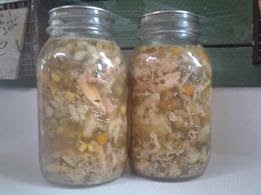
I thought I took a picture of all the jars in a row after I took them out of the canner, but here's
a close-up of the soup after canning. I shook them gently to mix the ingredients. My pasta didn't clump like it does sometimes but the noodles look pretty swollen and soggy. It'll be like chicken and dumplings when we eat it. I was out of fettucine noodles so I went ahead and used egg noodles.

This is some chili that I made and canned a few years ago. There were originally 21 quarts and we're down to the last few jars now. The only reason there is any left is that I put them away in a cabinet and forgot they were there. These were the 'overflow' that didn't fit on the shelves with the rest. We plan to eat them soon since they're almost three years old, but I'm sure they're still fine.
Back before I learned how to make my own soups I had only had store-bought soups, and I thought of them as "punishment food". Homemade soup is nothing like it's store-bought canned counterparts. Even if you don't want to make large batches and can them, you might enjoy trying out a few homemade soups.
Some of the better ones we've made lately are cream of potato soup with shredded cheddar cheese on top, and cream of tomato soup. I haven't made batches big enough to can yet but I am going to try that one day soon. I'm wondering if the milk in the soups could make them scorch during canning. If any readers have experience with this I would love to hear from you!
Please leave comments or questions below, or email them to me at:
Thanks!
Susan
